Vinyl vs Cast Iron: Kettlebells, Dumbbells and Weight Plates Compared
If you’ve ever picked up two kettlebells that are supposedly the same weight and found one looks nearly twice the size of the other, you’ve run into the vinyl vs cast iron kettlebell question. It trips people up because the two materials pack the same weight into very different amounts of space, and that affects price, durability, and how easy a piece of equipment actually is to use.
The short answer to the vinyl vs cast iron kettlebell question: it comes down to size and cost. Cast iron is smaller and more durable for the same weight, but costs more. Vinyl is cheaper and gentler on floors, but gets bulky at heavier weights. Which is right for you depends on what you’re buying and how heavy you’re likely to go, and the answer can differ for kettlebells, dumbbells and adjustable dumbbell plates, which is why I’ve covered all three below.
New to Strength Training?
Grab my free strength training guide and get started with a clear, simple foundation, no gym experience needed.
Kettlebells: Vinyl vs Cast Iron
Take a quick look at two kettlebells I have at home: a red cast iron one and a grey-green vinyl one. At a glance, most people assume the bigger, grey-green kettlebell must be heavier. It isn’t. The smaller red one weighs 14kg, the larger one only 10kg.
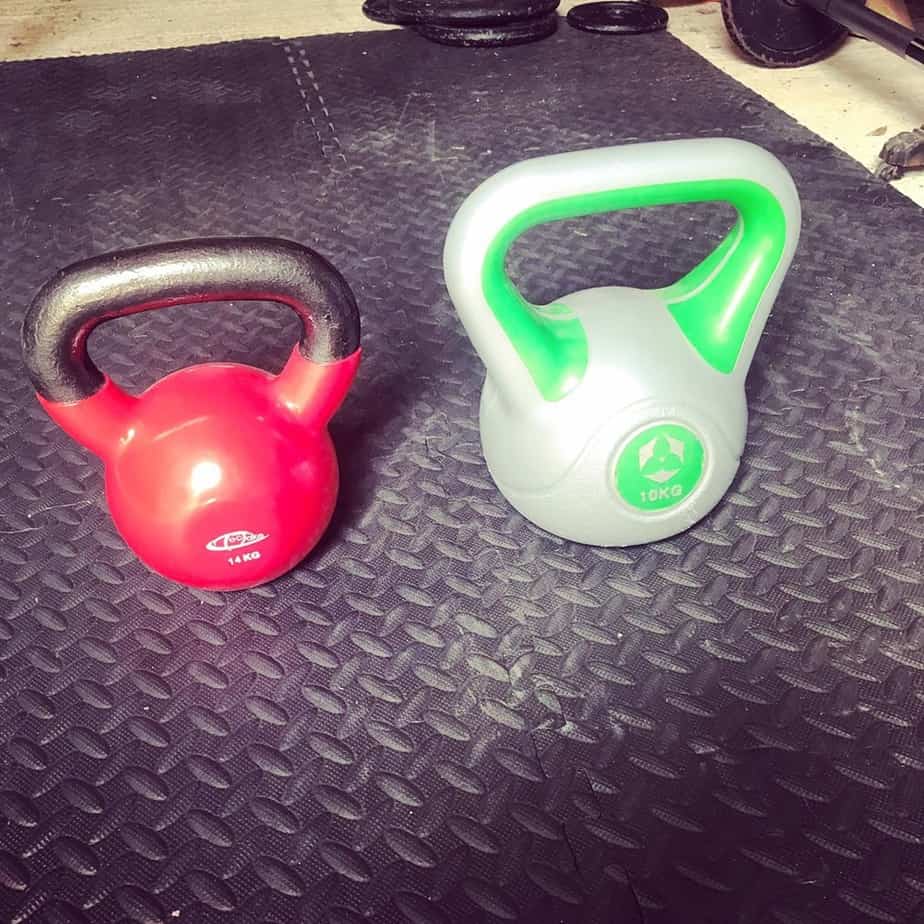
That’s the whole trade-off in one picture. Cast iron packs its weight into a dense, compact shell, so a cast iron kettlebell will always be smaller than a vinyl one of the same weight. That barely matters at lighter weights, but once you’re lifting heavier, a bulky vinyl bell can start getting in the way of exercises like cleans and rack positions, where the bell needs to sit close to your body.
Vinyl’s advantage is price, it’s often close to half the cost of an equivalent cast iron kettlebell. Since most people progress fairly quickly once they start training and end up needing several weights rather than just one, starting with vinyl is usually the cheaper way to build up a set.
My recommendation: Vinyl up to around 10kg, cast iron beyond that, once the size difference starts affecting how the exercises actually feel.
If you’re new to kettlebell training, the NHS has general guidance on building strength safely worth reading first.
Dumbbells: Vinyl vs Cast Iron
The same trade-off applies to dumbbells: a vinyl dumbbell will be noticeably bulkier than a cast iron one of the same weight, which matters more here than with a kettlebell, since you’re often gripping a dumbbell one-handed and moving it through a bigger range of motion, think overhead presses or single-arm rows, where a bulkier weight has more chance of feeling awkward. Vinyl is still perfectly fine at lighter weights, where the size difference is minimal and the lower cost is worth it.
My recommendation: Vinyl up to around 5kg, cast iron beyond that, particularly for anything overhead or single-arm, where the extra bulk is most noticeable.
Adjustable Dumbbell Weight Plates: Vinyl vs Cast Iron
Vinyl-coated plates do exist, but cast iron is by far the standard for adjustable dumbbell systems. Vinyl plates also have a larger radius than cast iron ones of the same weight, and it’s common for the edge of a vinyl plate to catch against your wrist or forearm during exercises like curls or presses, which is awkward and uncomfortable in a way that rarely happens with the more compact cast iron equivalent.
One practical thing to check before you buy: adjustable dumbbell systems aren’t all built to the same standard, so a cast iron plate from one brand won’t necessarily fit another brand’s handle. Always check compatibility with the specific system you own or are planning to buy before adding plates from a different manufacturer.
My recommendation: Cast iron plates for a genuine adjustable set, vinyl only for the smallest fine-tuning increments, if at all.
Other Things Worth Knowing
A few smaller factors worth knowing before you buy: cast iron is noticeably louder if you set it down, which matters if you’re training in a shared house or flat, vinyl is much quieter. Cast iron can also rust if it’s kept somewhere damp, like an unheated garage, so an occasional wipe-down is worth doing, vinyl doesn’t have this issue. On the plus side for organisation, vinyl sets are often colour-coded by weight, which makes it quicker to grab the right one without checking the numbers.
One more thing that catches people out: many cast iron kettlebells and hex dumbbells have a rubberised or neoprene coating for floor protection, which can look and feel similar to vinyl at a glance. The coating doesn’t change the core material underneath, so don’t rely on appearance alone, check the product’s weight against its size, or the listing itself, to confirm what you’re actually buying.
Quick Comparison
| Factor | Vinyl | Cast Iron |
|---|---|---|
| Size for a given weight | Bulkier | More compact |
| Price | Cheaper | More expensive |
| Durability | Can wear or split over time | More durable long-term |
| Best for | Lighter weights, floor protection | Heavier weights, long-term use |
Where to Buy
You’ll find kettlebells, dumbbells and adjustable dumbbell sets in both materials on my recommended equipment page.
Frequently Asked Questions
Are vinyl kettlebells any good?
Yes, for most people starting out. They’re significantly cheaper, protect your floors better if you set them down, and the size difference only really becomes a practical issue once you’re lifting heavier than about 10kg.
Which lasts longer, vinyl or cast iron?
Cast iron will generally outlast vinyl, the coating on a vinyl kettlebell or dumbbell can wear or crack over years of use, while cast iron has nothing to wear away. That said, a well-made vinyl kettlebell should still last for years of normal home use.
Can I mix cast iron and vinyl in the same set?
Yes, there’s no reason not to. Many people, myself included, use vinyl for their lighter weights and switch to cast iron as they progress, rather than replacing an entire set at once.
Which is better overall, vinyl or cast iron?
Neither is universally better, it depends on the weight range and your priorities. Vinyl wins on price, floor protection, and noise. Cast iron wins on compactness at heavier weights and long-term durability. Most people end up using both as they progress.
What are the disadvantages of cast iron weights?
The main downsides are cost (typically double the price of an equivalent vinyl weight), noise if set down on a hard floor, and a tendency to rust if stored somewhere damp. Uncoated cast iron can also be tougher on floors than vinyl if dropped.
My Overall Recommendation
Given that most people progress fairly quickly once they start strength training, you’ll likely end up needing more than one weight regardless of material. A sensible approach: start with an affordable vinyl set to get going, then add cast iron as you move up in weight, particularly for kettlebells and dumbbells above 10kg, and for any adjustable dumbbell plates. If you’re not sure how quickly you’re likely to progress, my post on reps and sets is a good place to start.
Want Support Along the Way?
Join Stronger for Life for weekly group calls, form feedback, and a community that understands what it’s like to start strength training later in life.



10 responses
Thanks for sharing some of the difference between the two types of kettlebells.
I like the idea of the variable kettlebells – a great way to save on space in a home gym too.
Yes, it’s a great idea. I’ve used the variable Bowflex dumbells before but didn’t realise they did the same for kettlebells.
I actually had no idea that they were different sizes. I use dumb bells that are coated with vinyl bc I like the feeling better than the iron. Also I think the iron makes my hands smell 🙂
Ha, can’t say I’ve ever noticed my hands smelling after using cast iron kettlebells. I will keep an eye out for it next time.
Great post! I don’t use kettlebells too often but I like the look/feel of the cast iron ones. It’s definitely nice to know that there are other options though! Thanks for breaking down the differences!
I have one kettle bell and I don’t use it much. I’m so used to my dumbbells that I seem to reach for those out of habit …
I would go for the iron because I’ve got a small frame. I don’t think I’ve seen vinyl ones yet but I can see the appeal.
Love the idea of a variable kettlebell! The regular ones are expensive and when you need several in different weights, it does add up.
I like the appearance of the vinyl ones, but I think the down and dirty cast iron or neoprene coated is more up my alley.
This was great to point out the differences! I have a vinyl one at home, but it is collecting dust, so I need to get back on it 🙂
I did not know about the difference in kettlebells. I am used to using the cast iron ones at the gym.